To riff on Tertullian – what has obedience to do with love? How does obedience to God show love for him? To our modern sensibilities, the two seem like opposing ways of relating to God, as philosophy and revelation seem to oppose one another in thinking about God. However, Scripture and the Church teach us that we offer our obedience freely to God and in doing so we love him.
Among its many entries, the Oxford English Dictionary defines love as a “strong predilection, liking or fondness for, or devotion to something.” Obedience it defines as “submission to the rule or authority of another; doing what one is bidden.” Love pertains to that which I will and want to do while obedience pertains to that which I must or ought to do, oftentimes contrary to my own will. The dictionary and our sensibilities conceive of love and obedience as unrelated, mutually exclusive of one another. Commonplace experience seems to bear this out.
Saint Augustine understands obedience differently. For Augustine, God’s commands and our obedience demonstrate that we have free will, because “wherever there is any requirement in the divine admonitions for the work of the will to do anything, or to refrain from doing anything, there is at once a sufficient proof of free will” (On Grace and Free Will, ch. 4). He adds later that “such precepts would not be given unless a man had a will of his own, wherewith to obey the divine commandments” (ch. 8).
We can obey God’s law and commands because we first have a will by which to act obediently—or disobediently—to God. Obedience, then, is not something we do against our will or passively out of compulsion. Rather, true obedience is fundamentally a free act of the will whereby one submits one’s own will in response to another’s.
We all realize this analogously in our friendships. Whether deciding where to get dinner, what show to watch, or what to do for Spring break, one friend sets aside his preference, his will in favor of his friend’s. And with our best friends, we may even propose what they want without them first suggesting it because we know what they want and prefer it to our own will.
Christ has realized obedience perfectly. Turning down his disciples’ offer of food, Christ says “My food is to do the will of him who sent me, and to accomplish his work” (John 4:34). This is a man, the God-man, so consumed with love for the Father and doing his will that he disregarded his own life and “became obedient unto death” (Phil 2:8), and he has called us friends.
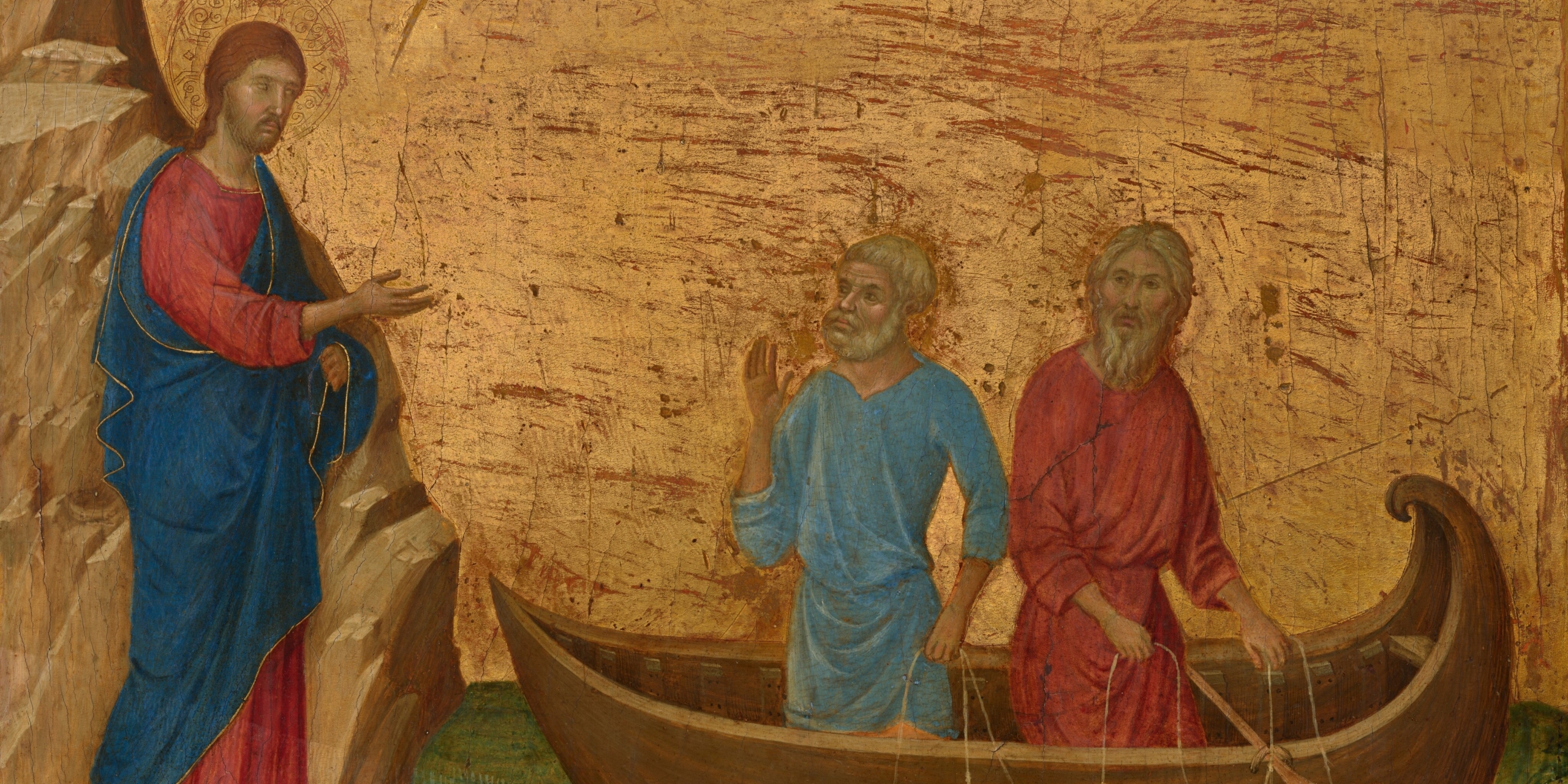
Christ has called us friends and has made known to us the Father’s will (John 15:15) by his life, in the testimony of Scripture, and through the Church’s teachings. Having made known God’s will, he neither demands servile submission from us nor desires groveling self-abasement. He asks of us something far greater and costlier: “Will you follow me?” Obedience to someone, something is presumed. Christ’s question requires of us a decision: to whom will we pledge our obedience? Will you obey God? Your ambition? Politics? The latest influencer? (Matt 6:24) Our answer reveals our love.
✠
Image: Duccio di Buoninsegna, The Calling of the Apostles Peter and Andrew