Sed Contra: An Essay on the Modern Culture
A “sed contra” essay is to engage a cultural concern and to address it with the help of some philosophical or theological authority.
The Church teaches through music—with good reason. What we let in affects us. Saint Paul preached Christ’s saving mission through the hymnody of his day (see Phil 2:6–11). Arius, by contrast, exploited “lewd and effeminate tones” to undermine the divinity of Christ (see Discourse Against the Arians, I.1). Ambrose, Augustine, and Aquinas each composed hymns, not merely as ornament, but as instruments ordered to the salvation of souls.
A late variation on the same theme is now working its way into pop culture: K-Pop Demon Hunters.
In just eight months, K-Pop Demon Hunters has become the most-streamed movie in the history of Netflix. The animated film has over 325 million views (beating #2 by nearly 100 million). As of this post’s publication, its most popular track, “Golden,” sits at 1.1 billion views on YouTube alone. The hype cannot be exaggerated. But how did a movie marketed to kids and set to the beat of Korean Pop reach this level of viewership? Simply put, they told a good story, and one which Christians should take note of.
KPDH tells a story intelligible only within a Christian account of hope. With a plot clothed in Korean folklore making no mention of Christ, KPDH manages to tell a unique story shaped by the logic of Christian hope—a story where healing requires truth, weakness gives way to redemption, and conversion is possible, albeit costly.
The film depicts K-Pop trio Huntr/x, three modern-day heroes who follow in an ancient line of demon hunters battling for souls with the age-old weapon of song. The story finds the hunters on the cusp of a final victory. If they can win the hearts of their fans with one final chart topper, they’ll be able to close the connection with the demon world forever. Yet in a final plan of desperation, Gwi-Ma, the fiery master of the underworld, tasks a demonic boy band, the Soja Boys, to dethrone Huntr/x and drag souls to himself.
Like most popular stories, the film depends on a simple narrative of good vs. evil. It’s paired with a straightforward moral message: what you let in, what you worship, shapes you. Lean on Huntr/x, with their weapons of light, and they’ll get you through the darkness. Listen to the demons, and you’ll surely find yourself alongside them. But unlike many stories, the clear moral division between characters retains the possibility for redemption and change. KPDH faces the complex patterns of good and evil running through every heart and poses a compelling question: Can you change?
The film opens with the typical struggle between good and evil, but it takes a turn when it’s revealed that the demon hunter Rumi is herself part demon (a biological conundrum better left a mystery). She has physical patterns on her skin, marking her since birth. It’s a secret she’s been hiding her entire life, and one which Jinu, the demonic frontman of the Soja Boys, threatens to exploit. Meanwhile, Jinu must face his own demons. It’s revealed that he was once human, kept now in slavery by the Gwi-Ma after shamefully selling his soul and turning his back on his family. Very quickly, the external conflict between Huntr/x and the Soja Boys converges with the internal conflict between self-awareness and self-deception. The arc of their redemption ends up entangled.
It’s Rumi who first recognizes that things are not alright. Be it things she’s done or things she’s endured, like her ill-begotten secret, she carries a world of shame in her head. A temporary solution is to ignore it. Jinu, likewise, is stuck in the past, and his stated goal is simply to forget it. But to recognize that something’s wrong requires at least an intuition of how it’s supposed to be.
Rumi isn’t a perfect protagonist. She may not even be a very good one. She’s weak—and that’s just the point. She can’t hide her weakness any longer, but instead must accept it. Only then can she begin to find real strength. And it’s true, Jinu will never be free. Healing won’t come through forgetting. There is hope for healing, but only by first naming her pain as the evil that it is.
After embracing the difficult truth of her own past, Rumi confronts her wounds—both her outward demon patterns and the pain of isolation they’ve imposed. She has to confront the reality of her shame. Shame is a kind of fear, not of things present, but of the past. It’s protection of the worst kind, concealing the pain of the past but cutting you off from the present. Paradoxically, it’s in her failure that Rumi reveals something of supernatural hope, a hope that is recognizably Christian. In the final struggle between good and evil, the Hunters narrate the spiritual stakes with a new track:
I broke into a million pieces, and I can’t go back
But now I’m seeing all the beauty in the broken glass
The scars are part of me, darkness and harmony
My voice without the lies, this is what it sounds like
Left ignored, shame cuts us from who we are by keeping us trapped in who we were. Yet in naming the source of her shame, Rumi lands on a profound truth: though her scars shaped her into who she’s become, it’s not who she has to be. Her physical wounds and heartache aren’t going anywhere. Yet brought to the light, they have become something beautiful. It’s a familiar trope, but it should give us pause to think.
A shallow read would see KPDH as one more story of self-acceptance without change. More affirmation of authenticity. In fact, it’s a complex story of redemption. KPDH makes a real moral claim. It dares to say that you can live without shame, but that conversion will cost you your own self-perception. And in a cultural moment shedding the dead weight of ethical agnosticism, KPDH has captured an audience through characters deep enough for real redemption. We should not confuse moral complexity with moral ambiguity. The story affirms the impact of past wounds on present decisions, yet does not overlook personal responsibility. The result is a mature moral framework—one that recognizes wounds are real, responsibility is unavoidable, and redemption is possible, but only through truth. That framework is recognizably Christian.
It’s the self-acceptance and self-transcendence of Rumi and her friends that inspire Jinu. He recognizes in their reunion a possibility of life beyond his slavery to shame. Through Rumi’s healing, he realizes that he, too, can be free. Inspired by their hope, he lays down his life in an act of sacrificial love. And thereby gives Rumi the strength to give the death blow to evil.
K-Pop Demon Hunters does not proclaim the Gospel, but it is steeped in Gospel logic. It rejects the easy lies of self-acceptance without change and hope without truth, offering instead a vision of redemption that passes from shame to healing, through truth and love. It evokes a hope daring to say that even the pain, suffering, and evil we endure can be used for healing and new life. In doing so, it forms the imagination in a hope the world cannot rightly name—but which Christians recognize immediately.
✠
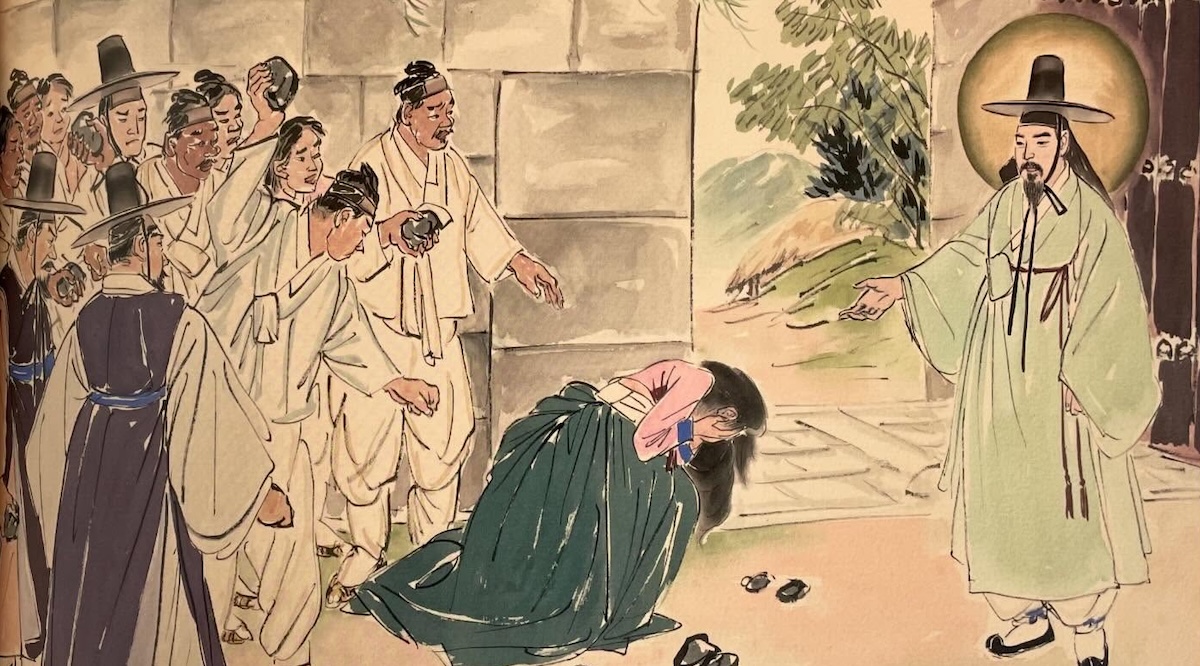
Image: Jesus and the Adultress by Kim Ki-chang (Public domain)