For four thousand winters Adam lay bound, bound by death, bound in death. So the medieval English hymn Adam lay ybounden has it. Not much is known about the hymn other than the parchment it is preserved on and speculations of its provenance. That is enough for our purposes. The one who hears it is pulled backwards to the beginning of recorded time, when Man deprived himself of Paradise. Now you shall be as gods (cf. Gen 3:5). Then a brother is murdered out of envy over his proper sacrifice (cf. Gen 4:3–8). The next moment: rain pours down and the deep wells up, drowning the world (cf. Gen 7:11). And in the blink of an eye: a man from Ur hears a call from a god he knows not (cf. Gen 12:1).
Yet this is not some mere record of change or an attempted retrieval of irretrievable moments. For God, all time is as one, and every single story ever lived in its truest form is known to him. God is not the god of the dead but the living (Matt 22:32). And only in God can we truly hope to see the glimpses of the eternal bearing of every free choice—for God meant it for good (Gen 50:20). We can see the meaning of history in our lives only in faith.
In this light, then, we may know that God saw the prostitute Rahab as a woman of ill-repute and as a woman predestined to save Israel: a sinner called to repentance by grace, for Joshua saved her and her family, brought her into the children of election (Josh 6:25, cf. Matt 1:5). After all, the name Joshua (also written “Jesus” in Greek) means “God saves.” We see the blood of the immolated Lamb of God in the scapegoat, sent over to Azazel (Lev 16:21–22). With the Tent of Meeting, (Ex 40:34), we see the Lady’s womb in which the dust of human flesh was divinized. At the rising of the sun nature bespeaks the rising of the eternal Son of Justice, or the uplifted Host surrounded by the golden rays of a monstrance. These stories and symbols are not dead records, irretrievable, but living and effective, sharper than a two-edged sword (Heb 4:12).
Yet there are many who say instead that the winding path through the woods is our home and not a passage to our true destination: struggle against the gloom or make your peace with it, there is no hope to be found; only the outward beauty of fleeting things, our existence suffocated with our last breath (Wis 2:2). This world, for them, is the only true life. Is that so?
No, it is not. Another way is offered—one only traversed with a special sight that sees farther than the most powerful telescope NASA could ever produce. “By your light we see light” (Ps 36:9). Jesus Christ commended those who believed what was before their eyes in his day. And in our day, he rewards those who believe what is placed before minds and hearts: “today this Scripture has been fulfilled” (Luke 4:21). And for some, the Lord offers miracles that attest to the words of life (ST II-II, q. 178, a. 1, cf. Matt 11: 2–6). Blessed are they who see the signs and wonders. Yet, as was said to Thomas, more blessed still are those who have believed without seeing (John 20:29), for no man has seen what God plans for those who love him (1 Cor 2:9), what the human heart was shaped out of clay for: do you believe this? (John 11:8).
Why do our lives happen this way or that? Are they meaningless? No, everything is meaningful—radically so: every tree and stone is pregnant with meaning; every life is a story told or yet-to-be. We have at last, as we travel forward, a choice. In which light do we walk? The one that knows this forest as the only world? Or do we walk by a different light?
✠
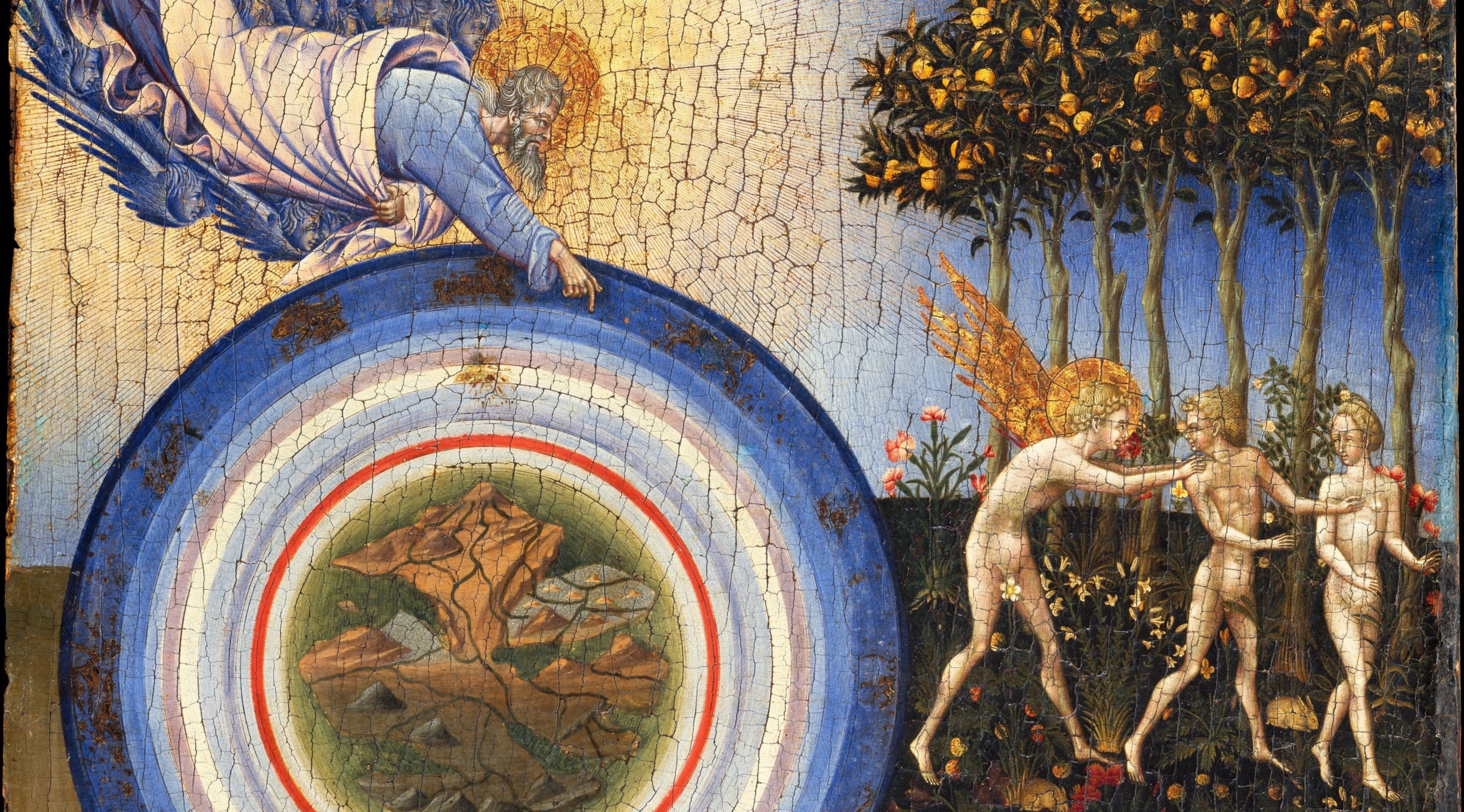
Image: Giovanni di Paolo, The Creation of the World and the Expulsion from Paradise