Saint Patrick need not have been the hero of Ireland. Kidnapped and enslaved by Irish raiders as a young man, he understandably could have held bitter resentment toward his captors. When he eventually escaped from his bondage, he could have left Ireland entirely in the past; he could have even sought vengeance for the wrongs done to him. But God changed Patrick in the midst of his suffering and deeply conformed him to his Son. A man deeply conformed to the Son imitates him and obeys his word: “love your enemies, and pray for those who persecute you, that you may be children of your heavenly Father, for he makes his sun rise on the bad and the good, and causes rain to fall on the just and the unjust” (Matt 5:44–45).
We know Patrick as a hero of Ireland because he looked upon the nation of his enslavers with mercy, and not with wrath. Patrick looked upon the Irish with the same loving gaze with which Christ looked upon his soul. Patrick’s mission in Ireland is famous because he tirelessly converted the pagan and un-Roman nation to Catholicism—this mission was only possible because of a supernatural love. For, as Christ taught, “if you love those who love you, what recompense will you have? Do not the tax collectors do the same? And if you greet your brothers only, what is unusual about that? Do not the pagans do the same?” (Matt 5:46–47)The pagans were bewildered by this Christian’s meekness. Patrick’s forgiveness of the injustice he suffered at the hands of the Irish clearly manifested to the pagans that something superhuman, something divine, something they could also possess was at work in him.
Patrick’s self-forgetfulness produced a love that bound him to the Irish. In love, he identified himself with the Irish, though he was not an Irishman by blood, and so countless generations of Irish Catholics adopted him in return. Many of the stories about Patrick get mingled with legend because his memory was so well preserved and deeply impressed upon the minds of centuries of Catholics. But not all of it is legend. Patrick’s deep conviction of voluntary servitude for Christ can be read in his very own words, written over 1500 years ago:
“In my human nature I was born free, in that I was born of a decurion [Roman officer] father. But I sold out my noble state for the sake of others—and I am not ashamed of that, nor do I repent of it. Now, in Christ, I am a slave of a foreign people, for the sake of the indescribable glory of eternal life which is in Christ Jesus our Lord.”
Today in the midst of Lent we pause to celebrate a man who exemplified Christ’s most Lenten virtues: self-abnegation and suffering love. During Lent we are constantly reminded that “though he was in the form of God, did not regard equality with God something to be grasped. Rather, he emptied himself, taking the form of a slave” (Phil 2:5–7). When Jesus washed the feet of his Apostles, of whom Patrick was a successor, he taught them “If I, therefore, the master and teacher, have washed your feet, you ought to wash one another’s feet. I have given you a model to follow, so that as I have done for you, you should also do” (John 13:14–15). The Apostles followed that model, and Patrick followed that model, as a successor to their office. Patrick knew that just as the Father “greatly exalted” Christ (Phil 2:9), so the Father would give him “indescribable glory” in heaven through that spiritual path. Today, while we refresh our bodies from abstinence, we still can contemplate the Lenten mystery of Christ’s passion and possess a soul like Patrick’s, one that knew suffering, but which overflowed with the joy of the Gospel.
✠
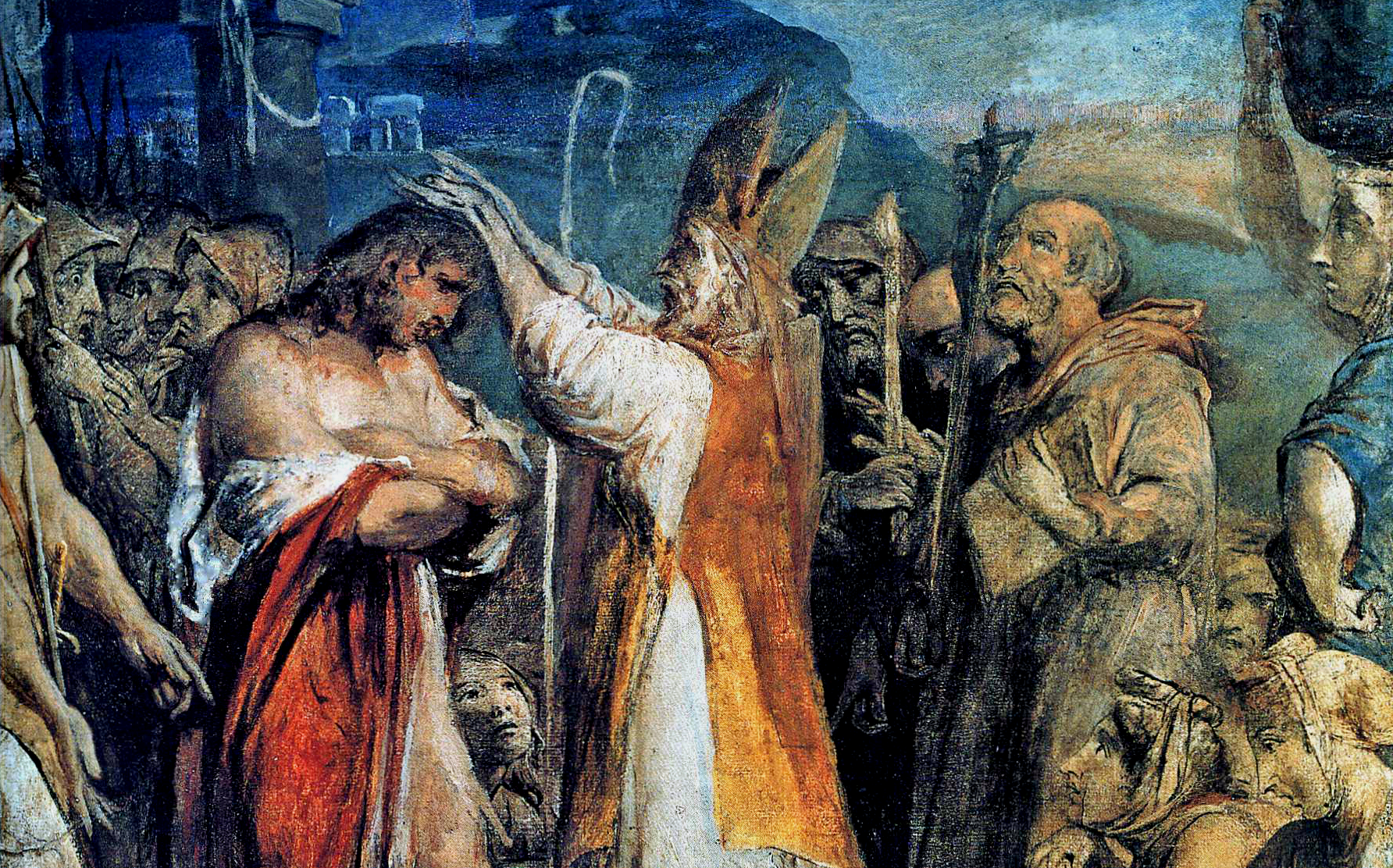
Image: James Barry, The Baptism of the King of Cashel by Saint Patrick