Lectio Divina: A Meditation on the Gospel
With the Gospel reading from the upcoming Sunday Mass as its principal source-text, each Lectio Divina (“Sacred Reading”) essay offers a prayerful meditation of the Sacred Scriptures—one which draws from the wealth of biblical literature, as well as the prayer life of the individual author.
One of my professors once quipped that Bach might be the greatest theologian who ever lived. Although I probably wouldn’t bet money on the truth of that claim, I do think that Bach’s music is full of theological significance. One of his most famous pieces of sacred music is the Johannes-Passion—a musical dramatization of the Passion narrative according to St. John. The text and music of Bach’s Johannes-Passion serve as a musical lectio divina that provides deep theological insight into the Passion.
John’s Gospel is characterized by opposition: the opposition between light and darkness, truth and falsehood, spirit and flesh, life and death, and between the Jewish authorities and Jesus Himself. This last opposition creates a tension that runs throughout the Gospel of John and that comes to a climax in the Passion narrative. The opening chorale of Bach’s Passion expresses the tension between Jesus and the authorities perfectly. While the tumultuous strings and accompaniment inexorably drive forward like the grim progression of Christ’s path to the cross, the wind instruments sound plaintive dissonances like the groans and wails of suffering humanity and its redeemer. With its portrayal of a tension that is close to a breaking point, this chorale sets the stage for the drama of human salvation that is about to unfold. The chorus enters with a strident tone, announcing, “Herr! Herr! Herr!” (Lord! Lord! Lord!). The English translation of this opening chorale reads:
Lord, our ruler, whose fame
In every land is glorious!
Show us, through your Passion,
That you, the true Son of God,
Through all time,
Even in the greatest humiliation,
Have become transfigured!
This opening text points to another unique characteristic of the Gospel of John: its contemplation of the divinity of Christ. Aquinas notes that while the Synoptic Gospels focus on the humanity of Christ, John in his sublime contemplation especially reveals Christ’s divinity (cf. Commentary on John, Prologue). Fittingly, Bach’s opening word is Lord, declaring that his divinity transfigures his humanity even in the most humiliating and terrible moments of his Passion. This is one of the great marvels of the Passion: that at one and the same time, in one and the same person, the most extreme suffering is present together with eternal blessedness. All this tension is masterfully communicated by the turmoil and relentless movement of Bach’s introductory chorale.
There are three forms of music found in Bach’s Passion: the chorale, the recitative, and the aria. This opening movement of the Passion is an example of the first of these: the chorale. The chorale is a harmonized, often hymnlike musical piece in which the whole chorus sings. Much like the chorus in the plays of ancient Greece, the chorale reflects on the narrative from a vantage point outside the narrative itself. Many of Bach’s chorales were hymns that were regularly used in the liturgy and which the audience would be familiar with. The chorales, then, provided an opportunity for a communal reflection on the narrative of the Gospel. As we saw with the opening piece of the Johannes-Passion, Bach’s chorales serve to provide a framework within which the Gospel texts can be appreciated.
Second, there are the recitatives: solo pieces that are designed to draw out the meaning of the text being sung. These chant-like lines of music narrate the text of the Gospel and the dialogues that it contains. While a tenor voice sings the words of the Evangelist, Christ’s words are sung by a bass. Although recitatives are usually simple in their musical design, without much modulation, Bach, by using his powerful ability for tone-painting, adapts the recitative in such a way that the music dramatizes and illuminates the meaning of the text. During the first performance of the Johannes-Passion on Good Friday, 1724, Bach’s potent dramatization in the recitatives did not fail to raise eyebrows. A more conservative Lutheran congregant exclaimed indignantly that the music sounded more like an opera than a religious service!
The third form of vocal music is the aria, and it is here that Bach’s genius for melody is most apparent. The aria is sung by a soloist and is accompanied by some combination of the orchestra. The arias provide a text drawn from German poetry that aims at a personal application of the truths of the Gospel to the members of the audience. In one of his greatest arias ever, Betrachte, meine Seel, Bach provides a heart-rending melody as a setting for a poetic text that portrays the bitter-sweet character of the Passion:
Contemplate, my soul, with anxious pleasure,
with bitter joy and half-constricted heart,
your highest Good in Jesus' suffering,
how for you, from the thorns that pierce him,
heavenly flowers blossom!
You can pluck much sweet fruit
from his wormwood;
therefore gaze unceasingly upon him!
Seeing these three forms of vocal expression—the recitative, the chorale, and the aria—as forming a unity, Bach’s Passion takes on the form of a lectio divina on the Gospel. This lectio alternates between the meditation on the text of the Gospel in the recitative, and the contemplative prayers of the arias and the chorales.
Monastic lectio is characterized by a careful reading of and meditation on the text (lectio and meditatio) which gives rise to prayer and contemplation (oratio and contemplatio). The Scriptural Word planted in the reader blossoms into earnest prayer to the Eternal Word, such that a conversation is kindled between the soul and God. The same dynamic between received text and proffered prayer is the basis for the distinction between the textual recitative and the meditative chorale and aria in Bach’s Passion. Indeed, Bach intended the Johannes-Passion to be heard and prayed as a lectio. Through his music, Bach wanted to bring the Passion of Christ into the lives of his listeners.
This Lenten season, as in every Lenten season, to live the Passion of Christ in our own lives is the task at hand. Therefore gaze unceasingly upon him! He, the Lord, the true Son of God! He who maintained his serenity throughout his Passion will also make us, even in the greatest humiliation, remain transfigured!
The best version for listening is conducted by Sir John Eliot Gardiner who has received multiple awards for his performances of Baroque music. His performances are shaped by his own extensive knowledge of Bach’s life and works.
✠
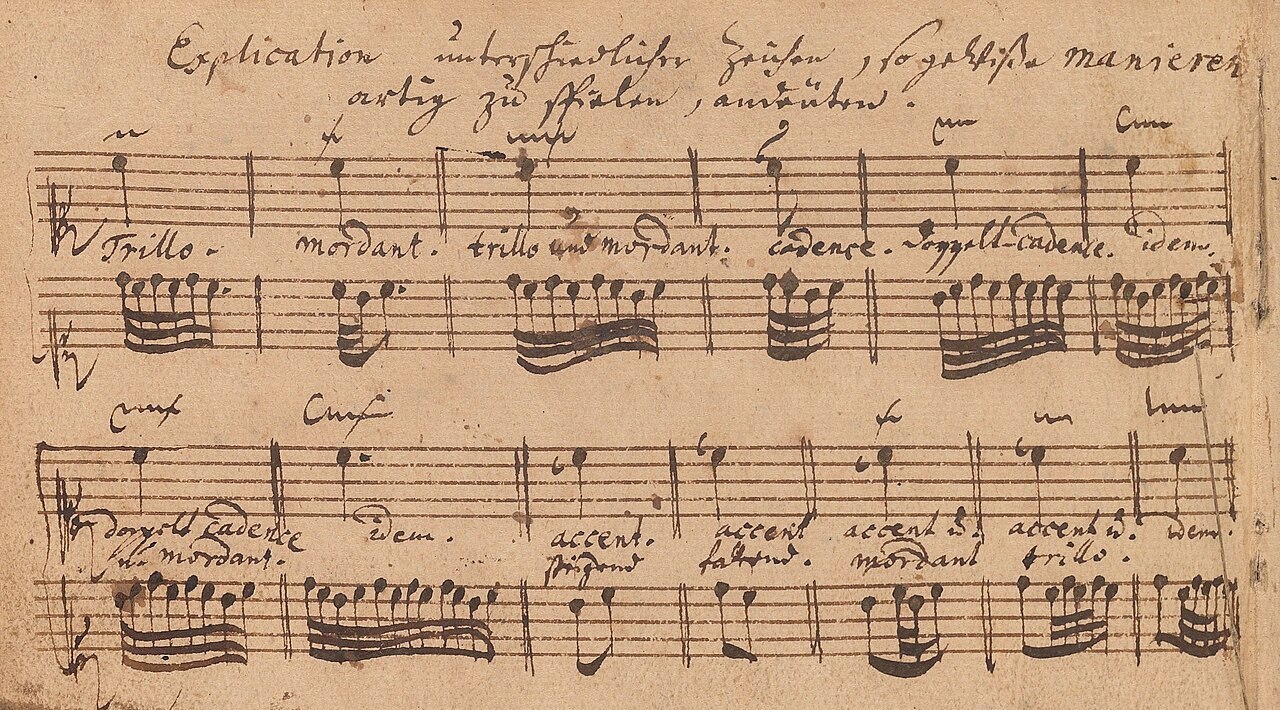
Image: Explanation of ornaments written in J. S. Bach’s hand, from the “Clavier-Büchlein vor Wilhelm Friedemann Bach.”