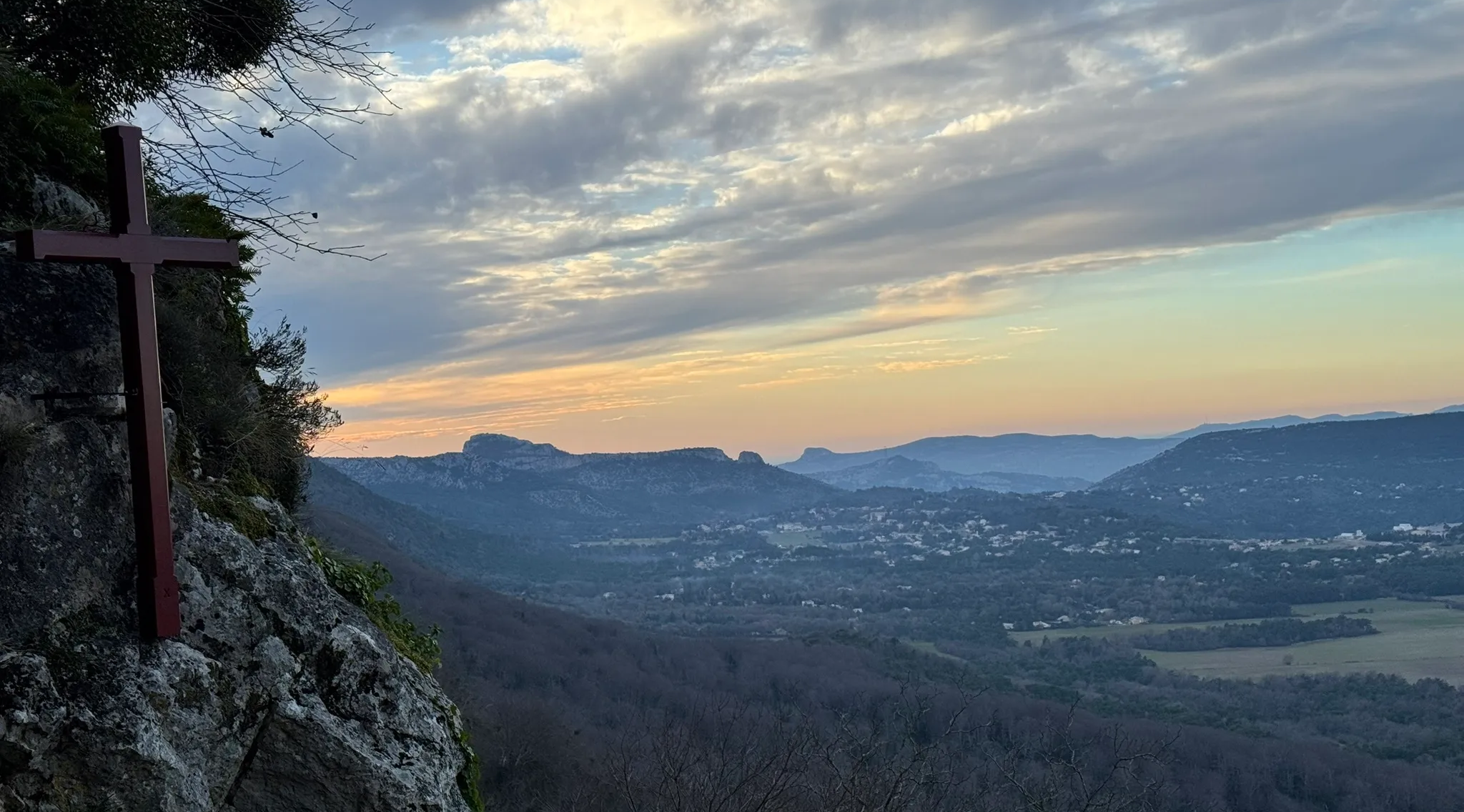
Tucked away in a dusty valley in the South of France, in the hill country that slopes up from the Mediterranean, there shines in the darkness of a medieval church a strange golden object. It is a reliquary in the shape of a woman’s head, like an ancient bust, complete with flowing golden locks. Where a beautiful face is expected, however, there is instead a glass pane. Behind it, a blackened skull, cushioned on red satin. Near the church, high up in a cliff facing northward, there is a cave. Looking out from the cave to the west, one sees, not too far off in the distance, the Mediterranean. To the east, only just observable with the naked eye, the snow-capped peaks of the Alps. The skull now in the church looked out from this cave every day. The eyes which once filled the sockets of that skull saw the Lord Arisen, and the jaw now set in permanent smile preached the first Easter sermon.
The skull and cave tell the story of Saint Mary Magdalene. Tradition has it that after the events of the Resurrection—maybe many years after—Mary Magdalene, along with Lazarus her brother, fled the Holy Land for Provence in the far West. It was on ancient French shores that the friend of the Lord found fruitful ground to spread the Gospel and live it. Yes, she counseled those who sought her wisdom and prayers, but surely there was also much to unpack in those long years—to unpack in silence. She willingly chose a cave as her dwelling, like a “dove in the clefts of the rock, in the secret recesses of the cliff” (Song 2:14). Mary chose the way of silent, hidden prayer, the cave becoming a holy grotto of contemplation.
She could remember that evening in the house of Simon, that place to which she was mysteriously drawn, impelled by love. The guest in that house—the man from Galilee whom she dared not approach before—the feet of whom she bathed with her tears. The words of mercy. “Your sins are forgiven. . . . Your faith has saved you; go in peace”(Luke 7:48, 50). The joy and wonder and knowledge that, once dead in sin with seven devils in her soul, she was now alive because of this man.
The springtime birds that dwell at the heights of her cave surely encouraged her each day with the reminder of that most glorious of spring days. The same voice she had heard dying on the Cross, saying now: “Mary!” (John 20:16). That one word which turned, changed, converted her whole life once more: “She turned and said to him in Hebrew, ‘Rabbouni,’ which means Teacher.”
And what was she to reflect upon most of all—turning it over again and again until it became a part of her very being— if not the command of her Resurrected Master: “Do not be afraid. Go tell my brothers to go to Galilee, and there they will see me”(Matt 28:10). “Mary of Magdala went and announced to the disciples, ‘I have seen the Lord’” (John 20:18). Her contact with the Risen Christ made her a preacher of new life. The soul raised to life lives in the truth that God has created her in his love, suffered with her in the flesh, recreated her in his grace, and prepared her for glory through his Resurrection.
Such meditation strikes me as a good way to spend the remainder of one’s life, in any state. For the Resurrection means nothing if it doesn’t mean that we, too, will be raised from the dead in body and soul by Christ’s power. We have all known the house of Simon, when the Lord’s mercy first struck us to the core—perhaps it was decades ago, perhaps this Holy Week. We all today gaze on the Empty Tomb as the angels, the Gardener, the Living God hover nearby to confirm that, yes, this has really happened: sin has been destroyed, paradise unlocked, humanity freed and Jesus glorified. And, having run the race successfully, we will all one day gather with Mary before the Redeemer for one last Reckoning and Resurrection, rendering a final doxology in the flesh that will never end. As we bow, Mary’s locks will once more brush the ground, near to the Feet they once dried in love: Glory be to the Father, and to the Son, and to the Holy Spirit, as it was in the beginning, is now. . . And as we rise and look up—and will be forever. Amen.—we, too, will be able to join Mary Magdalene in saying forever: “I have seen the Lord.”
✠
Photo from Grotte Sainte-Marie-Madeleine by Didier Pillot on AllTrails