“Behold the wood of the cross on which hung the salvation of the world.” When we hear the priest proclaim these words at the liturgy later today, perhaps we should also recall the annual proclamation of our optometrists. Gesturing toward yet another set of letters on the wall, he asks: “Now, what do you see here?” Jesus willed to undergo His Passion in order to help us see.
Does pain change its meaning during Lent? Does misery, anxiety, and injustice become something new during Holy Week? Does suffering become good on Good Friday? The answer, of course, is no. Suffering is an evil all 365 days of the year. But if suffering never becomes good, not even on Good Friday, why did the Lord Jesus desire to suffer for us today? Although, even today suffering is still suffering, it is also true that today, more than on any other day, Jesus accomplished our salvation. Yet he accomplished this salvation not by suffering so much as by loving.
This is the teaching of the Catholic Faith: charity is the cause of our salvation. Saint Thomas summarizes it very aptly saying, “It must be borne in mind, however, that Christ’s death derived its power of atonement from his charity whereby he accepted death voluntarily” (SCG III, ch. 55). More than the suffering and death of Christ, it is his love that saves us. “Christ’s death sufficed to expiate the sins of all men . . . by reason of the sublime charity whereby he suffered death” (SCG III, ch. 55). Apart from charity, suffering and death have absolutely no value. In itself, suffering is just as bad on Good Friday as on any other day.
Here a faithful man might object, asking, “If this is all true, why should the Lord suffer at all? If the power of redemption comes from love, it makes the Passion unnecessary.” Many people are surprised to learn that St. Thomas agrees: God could have saved man without the Lord’s Passion. Surprising as this may be, St. Thomas unequivocally teaches, “Speaking simply and absolutely, it was possible for God to deliver mankind otherwise than by the Passion of Christ” (ST III, q. 46, a. 2). In short, God did not somehow need suffering in order to save man.
“Then why,” our objector replies, “did the Lord will to suffer today?” Saint Thomas answers with five reasons why Christ’s Passion is the “most fitting” way of saving man. Let us consider just the first reason: the Passion is fitting because “man knows thereby how much God loves him, and is thereby stirred to love him in return, and herein lies the perfection of human salvation” (ST III, q. 46, a. 3).
In the Passion, God makes his love for us visible. Though Christ could have redeemed us by some other means, he chose the cross so that we would see his love. Like any lover, Jesus wanted to manifest the extent of his love with an extravagant gesture. His Passion is just this sort of grand romantic gesture aimed at winning our affections. In fact, every step on the via crucis is calculated to stir our hearts to love him in return. This return of love to God is the “perfection of human salvation.” In other words, the Passion does not merely deliver us from Hell but brings us even to the love of God. Christ suffers in order to show us God’s love. Saint Paul teaches this also when he says, “God shows his love for us in that while we were still sinners, Christ died for us” (Rom 5:8).
What then should we look for on Good Friday? We should not look for Christ’s suffering only. Instead, we should look for God’s love manifested in the offering of his Son. If suffering as such is repugnant to us, love is attractive; though we recoil from suffering, love is magnetic. Love, not suffering, causes the bride to say, “Draw me after you; let us run” (Song 1:4). Seeing Jesus’ love for us will move us to love him in return.
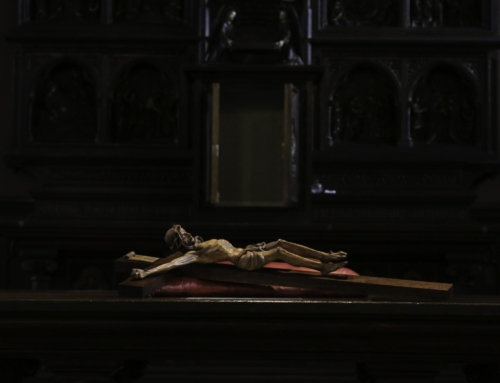
“Behold the wood of the cross.” The priest proclaiming these words hoists the cross above his head for all to see. He becomes, as it were, a spiritual optometrist asking, “Now, what do you see here?” Rather than reading off a string of random letters, we will read a few very important ones: INRI. Today we will see Jesus of Nazareth, King of the Jews, hung upon a cross. As we genuflect and adore the cross, may God grant that we begin at last to love Him in return.
✠
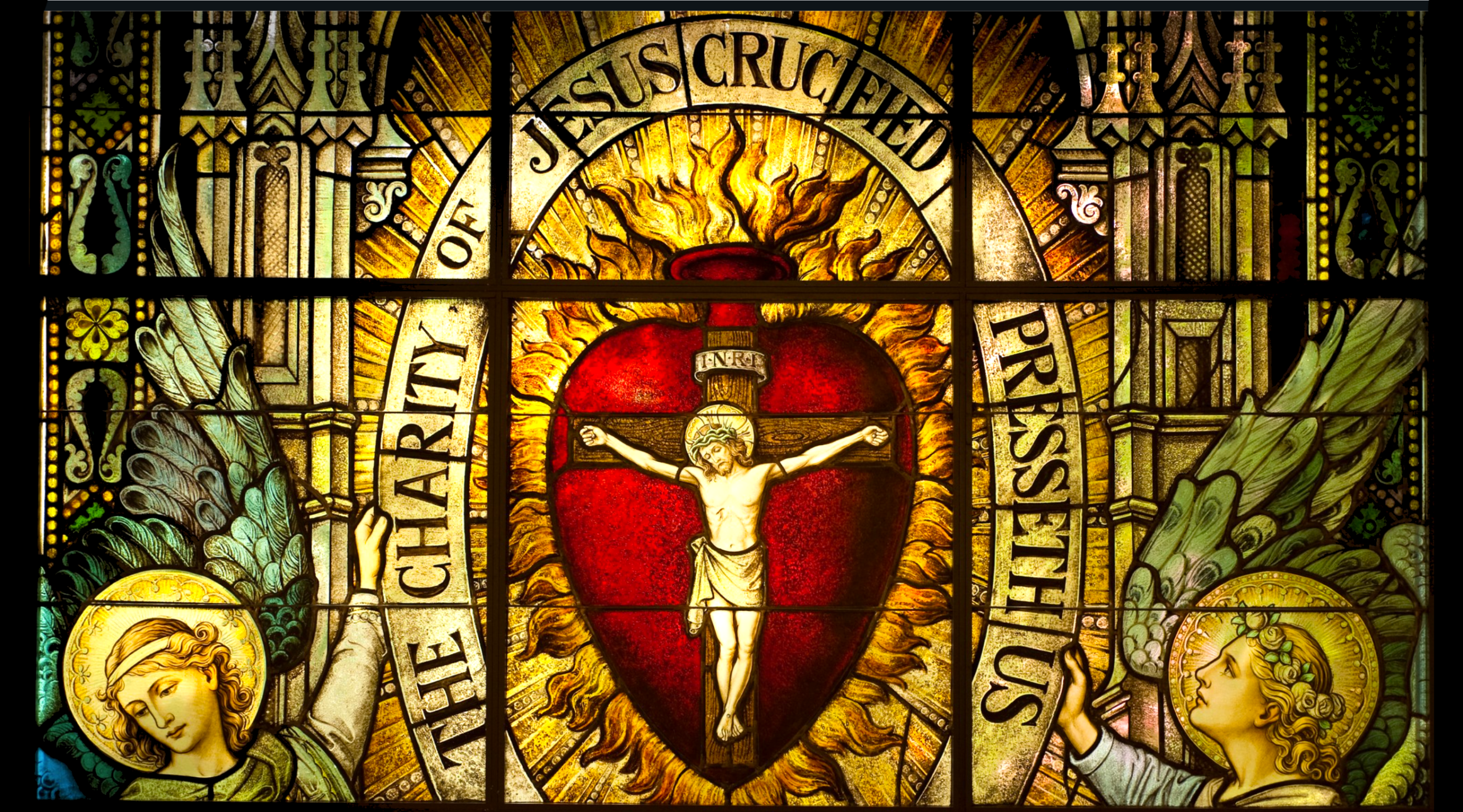
Image: The Seal of the Daughters of Charity from a stained glass window in the Provincial House Chapel in St. Louis. Photo by DaughtersOfCharityUS on Instagram.