Despite living in one of the most prosperous and peaceful eras of human history, contemporary society is plagued by a widespread affliction of anxiety. How can we explain the sudden and profound recent increases in anxiety-related disorders? And, more importantly, what is the solution?
First, we must recognize that anxiety is not caused by the mere presence of external threats, but rather concerns how we relate to those threats—whether big or small, real or imagined. When in threat-detection mode, the brain is on high alert: reflexive, ready for action, and highly distractible. Today we attempt to soothe ourselves with an incessant intake of “content,” yet the constant consumption of short-form videos and social media posts only exacerbates the impulsivity we hoped to quiet.
This fast-paced, ephemeral culture of distraction is both a cause and an effect of our anxiety. When our brains are on high alert, the absence of constant distraction often invites overwhelming intrusive thoughts: fear of the future or negative self-judgments. This generalized anxiety makes it difficult for many to be quiet and alone with their own thoughts. In turn, the more we flee from these sources of anxiety, the more power they have over us. For example, what begins as mere discomfort in public settings can gradually escalate into crippling social anxiety, leaving some virtually housebound.
Saint Thomas Aquinas, making use of the psychology and physiology of his day, described fear as a kind of “contraction” (STI-II, q. 44, a. 1). We are drawn inward, both physically and mentally. In moments of physical danger, real or perceived, the body restricts blood flow to the extremities to aid the fight-or-flight response. Psychologically, persistent anxiety causes a similar inward retreat. When excessive, these feelings become debilitating.
This image of fear as a contraction or withdrawal helps us understand the proper antidote to anxiety. Fear dominates our lives when we are conditioned to flee from perceived threats. By always yielding to our internal alarm system, we reward the brain for having warned us. Consequently, the next time the threat appears, the “alarm” will be even louder, and our anxiety worsens. Rather than recoiling and withdrawing from our fears, we should extend ourselves and, in fact, embrace the fear in order to disarm it.
This is what Jesus Christ himself has taught us as the path to true peace. Christ came to deliver us from the “lifelong slavery” imposed by the devil through the “fear of death” (Heb 2:15). How does Christ free us from such fear? Not by fleeing death, but by embracing it. Like an older brother venturing into danger to show us the way is safe, Jesus passes through death into eternal life. Thus, he bids us take up our cross daily (Luke 9:23). Approach the cross; do not flee from it.
Here’s what this might look like in very practical terms. Take whatever is your source of fear or anxiety—be it spiders, flying, or public speaking—and embrace it as your cross. Reframe the suffering you are experiencing as an opportunity to draw closer to Christ and be united with him on the cross.
In the moment, say a little prayer, and offer your rapid heartrate, or shortness of breath, or your trembling hands, as an offering in reparation for your own sins or perhaps as a prayer of petition on behalf of a loved one. In this way, by approaching this situation as an opportunity rather than a threat, the power it has over you will actually be dissipated.
This principle of daily taking up our cross applies broadly. The more we run from our fears—giving in to distraction, procrastinating on overwhelming tasks, avoiding the quiet—the more enslaved we become. Instead, we overcome anxiety by soberly embracing the fears, pains, and boredom we chronically seek to avoid. Rather than attempt to soothe ourselves with distracting entertainment, we can take up a practice of prayer that will actually be healing for us at the root.
This is the paradoxical wisdom of Christ. Fleeing the cross enslaves us to fear; embracing the cross sets us free. “Whoever seeks to preserve his life will lose it, but whoever loses his life will keep it” (Luke 17:33).
✠
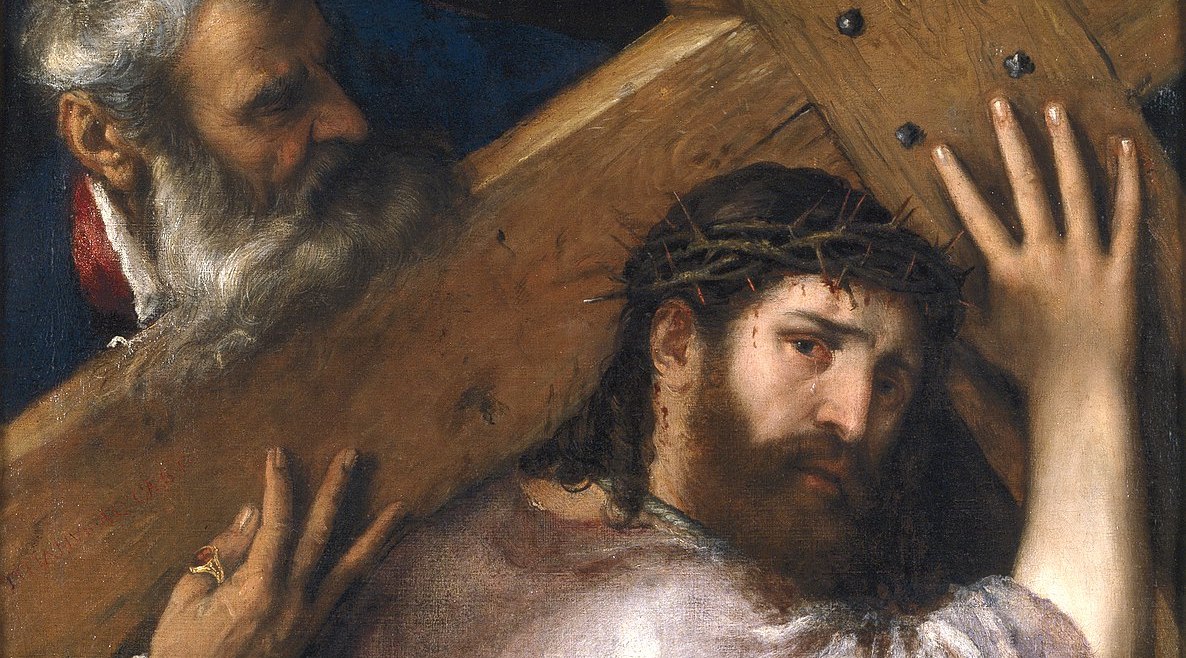
Image: Titian, Christ Carrying the Cross