
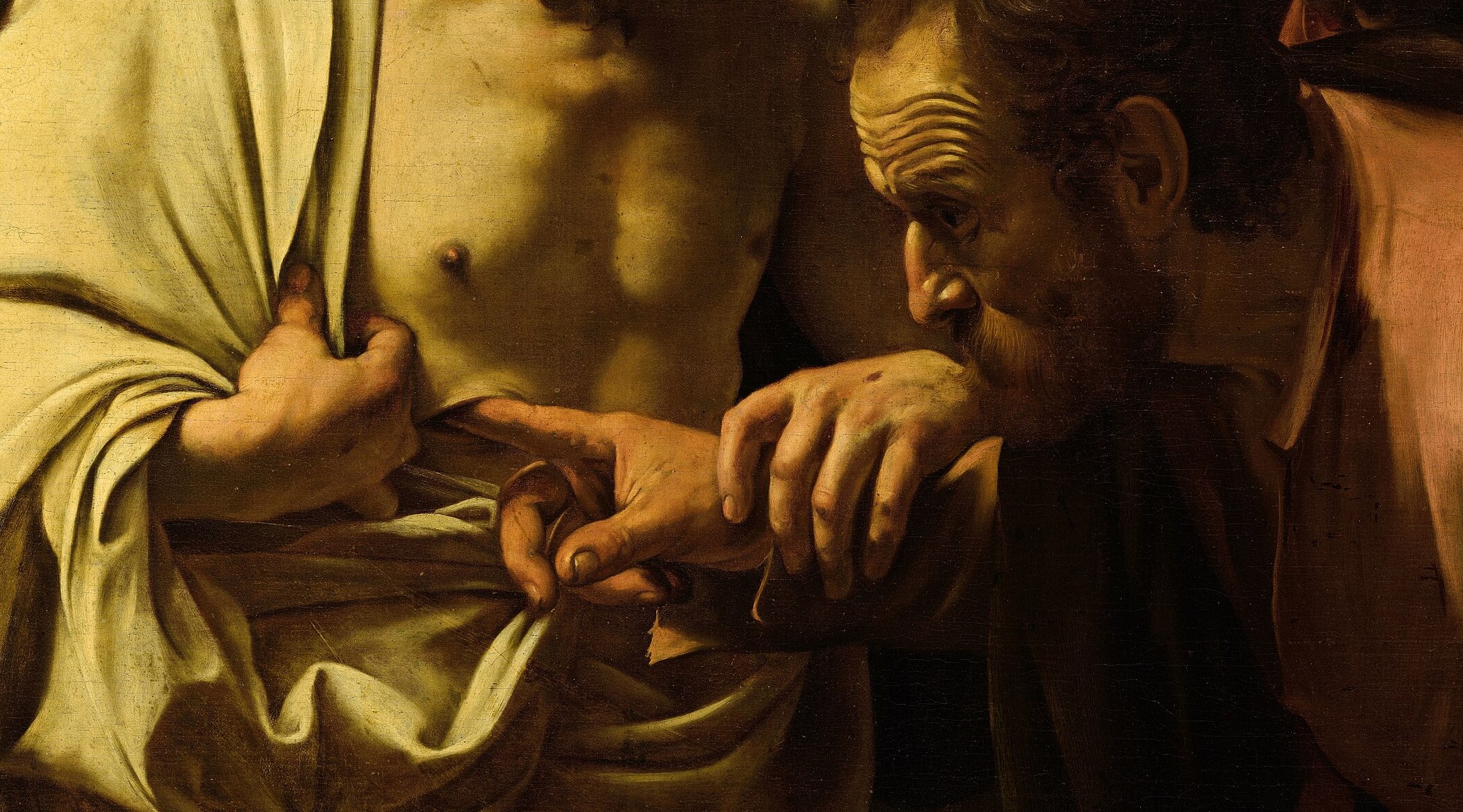
“Wait…his hand is in him!?” cried the boy. Kids were screaming, markers were flying, little girls were pretending to faint, all at the sight of this provocative image.
During my novitiate year in Cincinnati, I had the pleasure of visiting a 3rd grade classroom every week, with one of my final lessons being on the resurrection of the body. After reading aloud the story of Jesus encountering Thomas, I showed the kids Caravaggio’s The Incredulity of St. Thomas. They were shocked.
This painting is visceral. The light cascading in from the upper left, illuminating Christ’s body. The faces of Peter and John as they gaze at the Lord. The skin on Jesus’ side, freshly split. The finger deep within Christ’s side and the look of uncomprehending astonishment in Thomas’ eyes. In Caravaggio’s genius, you can almost feel the wound along with Thomas. It is raw, it is explicit, it is real. Along with the kids, it leads one to ask, “why are Jesus’ wounds still there?”
It seems contrary to human reason to think that something made perfect would retain the markings of imperfection. If Jesus truly conquered death, why would he choose to keep the wounds from his crucifixion? He could just close them and erase the scars, why doesn’t he?
Christ keeps his wounds as a testament to his victory. Just as he invited Thomas to feel, Jesus invites us to touch his wounds so that we too may believe in him (ST III, q. 54, a. 4).
Moreover, these wounds did not go away but remained as he ascended into heaven where they continue to give witness to his saving love for us. The way that he appeared to the Apostle Thomas is the way he plans to greet us at the end of time: bearing his wounds to receive us into his victory.
The eternal presence of Jesus’ wounds in his glorified body hold implications about the presence that our own wounds will carry into eternal life. While contemplating this idea, St. Augustine remarks,
Perhaps in that kingdom we shall see on the bodies of the Martyrs the traces of the wounds which they bore for Christ’s name: because it will not be a deformity, but a dignity in them; and a certain kind of beauty will shine in them, in the body, though not of the body. (De Civ. Dei, Book XXII)
For the saints in heaven, their wounds are not a negative brand from the past but a testimony of the saving power of God in their own lives. We each experience the “valley of tears” in a particular way as we journey through life. People hurt us, sin hurts us, and we hurt ourselves, all manifesting in wounds that we wish could simply disappear. We externally plead, “Lord, heal me!”, but really mean “Lord, fix me!”, longing for him to remove all traces of our wounded past. We want him to stitch up our pierced sides and magically erase the scar so that we can pretend the wound was never there. Yet, Jesus doesn’t choose to do that. He heals us, but leaves our wounds on display.
Jesus retaining his wounds teaches us that the wounds we endure are not condemnations from a shameful past, but are the means by which God brings us to heaven. Our crosses, while feeling like instruments of extreme torture while we drag them along, become instruments of our salvation. Our wounds, deep as they may cut, become the entry points for Christ to enter into our souls and make our own brokenness a trophy through which God shines his glory.
Unlike the 3rd graders, we should not be scandalized to see Jesus’ wounds or, in turn, to see our own. Let’s not cry out in distress at the sight of our brokenness, but let us join St. Thomas as we gaze at Christ’s wounds and rejoice “My Lord and my God!” (John 20:28) while joyfully anticipating the glorification of our own wounded selves.
✠
Image: Caravaggio, The Incredulity of St. Thomas


#/media/File:Der_ungl%C3%A4ubige_Thomas_-_Michelangelo_Merisi,_named_Caravaggio.jpg)