
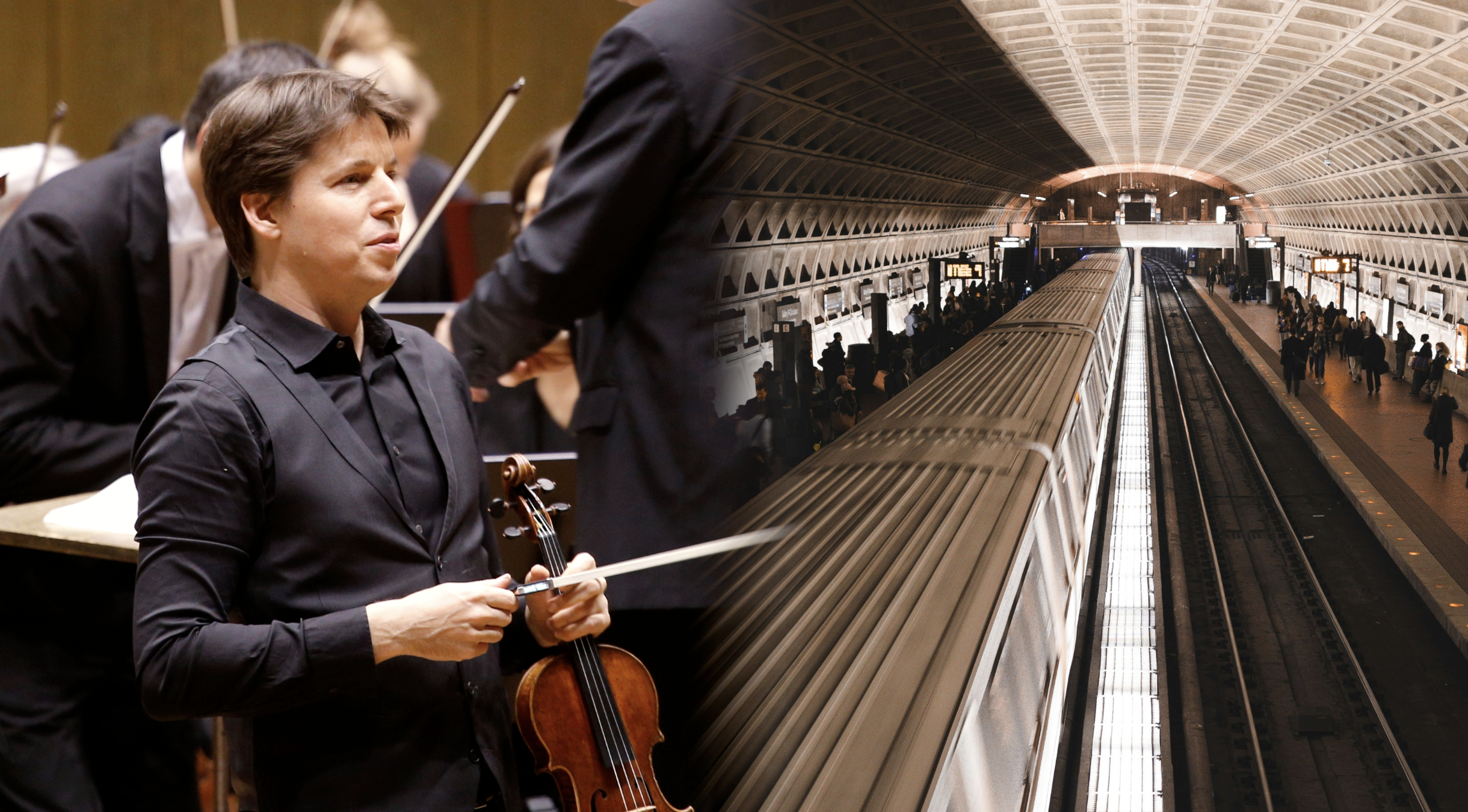
On a busy but forgettable January morning in 2007, over a thousand D.C. Metro passengers rushed by a busker playing a violin inside of L’Enfant Plaza station. Three months later, the Washington Post article “Pearls Before Breakfast” revealed that the busker was the virtuoso violinist Joshua Bell, conducting a social experiment. The article and accompanying video, which came to be known as the “Stop and Hear the Music” stunt, shocked the country and amassed millions of views. Very few people had paused to listen to “one of the finest classical musicians in the world, playing some of the most elegant music ever written on one of the most valuable violins ever made” (G. Weingarten, “Pearls Before Breakfast”). People reading “Pearls Before Breakfast” and watching footage of commuters giving Bell no attention were asking themselves: would I have stopped to hear the music?
You certainly don’t have to be a Christian to be moved by the “Stop and Hear the Music” stunt. But as Christians, we have the capacity to be especially attentive to beauty. No matter how much is going on in our day, no matter how much suffering is in our lives or in the world, we are invited to live in the joy of the Resurrection and the freedom of the Gospel. Living in this way allows us to be pulled out of ourselves by something beautiful. It makes us the kind of people who will hopefully stop and hear the music.
But for the Christian, the “music” worth stopping for isn’t only literal music. In the Christian life, the presence of God is at all times a certain “music”—and it’s worth stopping for. We are always invited by God to be recollected in his presence, no matter where we are or what we are doing. And one of the most helpful ways in which we can be recollected is by being pulled out of ourselves by something sublime—because in anything beautiful, true, or good, God is there. But to be able to see God in the sublime, we have to recognize it. We have to realize, unlike many of the metro passengers in L’Enfant, that there is music playing. And then, we have to stop.
In our busy lives, when we aren’t in the quiet of a chapel or gazing at the pages of Scripture, what is more sublime than the human person in front of us, created in the image and likeness of God? Do we see our neighbor as C.S. Lewis describes in “The Weight of Glory” as “next to the Blessed Sacrament . . . the holiest object presented to [our] senses”? Do we stop and hear the music of each and every person we encounter, rich or poor, friend or stranger? Are the celebrities of politics and sports and Hollywood about whom we obsess as we scroll through the internet just topics for endless gossip and awkward idolatry? Or could we possibly recognize that like our precious families and friends, they too have Christ in them? Can we stop and hear the music of their dignity?
Seven years after his train station debut, Bell held a short concert—publicized this time—in the grand entrance hall of D.C.’s Union Station. I sat on the floor only a few yards from where he was standing. When D.C. got a do-over, people stopped to hear the music. But would that we Christians could be so recollected that we recognize the music of God’s presence in our neighbor the first time, even in the busy L’Enfant Plaza of our day, and stop to hear it.
✠
Photo by Alexander Böhm (CC BY-SA 4.0) and Photo by Andy Feliciotti on Unsplash, edited.


.jpg)