I remember a scene from the neo-noir science fiction film Blade Runner 2049: set in a sleek, bleak Los Angeles on a drowned and poisoned earth. The primary antagonist of the film, the blind, visionary businessman Niander Wallace, looks to secure an ocean of disposable labor in the form of androids. He describes the infertile, artificial womb of the female androids as a “barren pasture, empty and salted . . . The dead space between the stars. This the seat that we must change for Heav’n.” Drawing from the Puritan poet John Milton’s magnum opus Paradise Lost (Bk. I.243-244) Wallace pronounces his goal of overcoming the barrenness of the womb of his female androids, which is his kingdom of Hell. He seeks his Heav’n—a greater prize, androids that bear children like human beings. Wallace wants fertility on his own terms, under his own control. He is like Lucifer, who, a few lines later in Paradise Lost delivers his famous judgement, deeming that “To reign is worth ambition though in Hell: Better to reign in Hell, then serve in Heav’n” (Bk. I.262-263). This pernicious sentiment animates the whole of Lucifer’s work in the poem, and of the Devil’s operations in our world: his rebellion that attempts to invert God’s saving will, that seeks to corrupt its goodness and to teach us to shirk our burdens when they weigh down greatly upon us. For Wallace, infertility is an obstacle to be overcome for profit. For Lucifer, infertility is a way to pervert God’s plan.
In the light of the Old Testament, a Christian sees the affliction of infertility differently: a barren womb is both a terrible consequence of the Fall and a wrong that will be made right. As recounted in Genesis 3:16-19, even the ground itself is cursed on account of Eve’s seduction by the Devil (and Adam’s complicity). As a consequence, in this crooked world, childbearing itself will be painful and dangerous—or frustrated. Only a few chapters later, Sarah, Rebecca, and Rachel find themselves afflicted in this way (cf. Gen 16:2; Gen 25:21; Gen 30:1-2). As in Genesis, so too in the Book of Samuel: the Lord closed Hannah’s womb (1 Sam 1:5). Hannah wept bitterly, and beseeched the Lord to end her affliction. If so rewarded, she would consecrate her son to the Lord. “And the Lord remembered her” (1 Sam 1:19). Sarah bore Isaac, Rebecca bore Jacob, Rachel bore Joseph, and Hannah bore Samuel—“For nothing will be impossible for God” (Luke 1:37).
This is true, too, with the womb that bore the Blessed Virgin Mary. According to an ancient tradition of the Church, the Blessed Virgin Mary was born to Saints Joachim and Anne (etymologically the same name as “Hannah”). After their prolonged infertility was too much to bear, the couple separated. The Lord sent a messenger to both, revealing his plan to bring forth a glorious child from them. A barren pasture no more.
In the lives of these righteous ancestors of Christ, we see all of salvation history: Israel, stricken with shame and amidst the weight of sin, seeking God. The shame of the barren womb is a sign of our existential separation from God, of the corruption of the world engendered by the Fall; in this world the barrenness of the soil and the womb are mirrors. Yet, it is still the Lord who turns this affliction to good, to prayer and divine communion. God fills the privation of infertility with the grace of his mercy (cf. ST I, q. 21, a. 3). God in his fathomless mercy rights the wrong of Adam, and sweetens the salt of the curse of Eve.
By this miracle, the fruitfulness of a barren womb, the Lord reveals his saving plan in the lives of the children of Israel. We see its perfection with the Blessed Virgin Mary, she who was to bear the child who shall rule the nations with an iron rod (cf. Rev 12:5). Indeed, Wisdom looked for a place to take root, and found it in Jerusalem, among the honored people of the Lord (cf. Sir 24:11-12). In all this, we see the Immaculate Conception of the Blessed Virgin Mary. In the Blessed Virgin Mary, we see the singular fruit of the spiritually barren womb of the whole human race. Mary is that sweet meadow that bore the Savior of the world. Through Mary’s unsown womb, born of the once-barren pasture of Saint Anne, eternal life dawned upon the human race: the bread of the finest wheat reaped from salted earth (John 17:3).
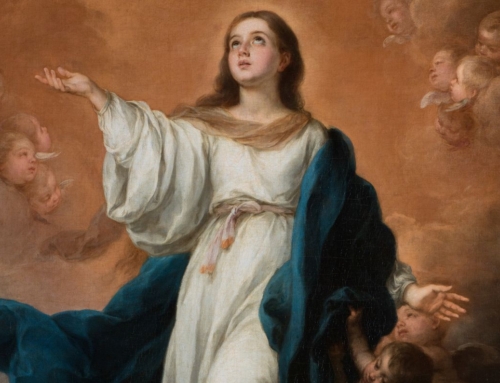
The Immaculate Conception of the Blessed Virgin Mary is a singularly important act of God’s saving plan for every man. It is only by the radiant light of the woman clothed with the sun (Rev 12:1) that we see the Sun of Justice, Jesus Christ, the Lord of Lords, God in the flesh. The Blessed Virgin Mary is a new creation fashioned by grace, a sweet meadow to all who wish to reap salvation (Akathist hymn, Kontakion 3).
✠
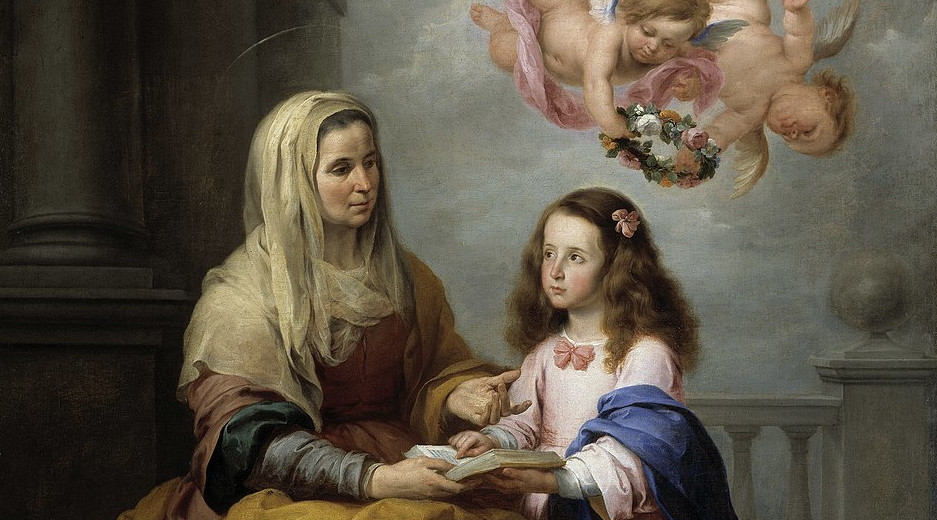
Image: Bartolomé Esteban Murillo, Saint Anne Teaching the Virgin to Read