On the edge of Advent, we stand on the edge of heaven and earth. Last week, at the end of the liturgical year, Mother Church sang with earnestness, “Maranatha!—Come, Lord, come!” In eager expectation for the future age, the Christian looks up to heaven, to the mountains of God, for her Savior to arrive. Now this week, our anthem is similar, but, in paradoxical fashion, we look backward as well as forward. The end is close. The beginning is far away. The Child was born 2,025 years ago. The Child will be born in four weeks. The Judge was an Infant. The Infant will be the Judge. The end is certain. The beginning was anything but.
But this edge, this turning point, this time of paradox is not some high precipice on which we stand—it is in fact the bottom of the deepest depth. We remember the moment that man’s woes were reversed. Full low tide. From this lowest low, we beg with the prophets of old, “Ye heavens, open from above that clouds may rain the Just One” (see Isa 45:8), hopeful of new life to reach us, for a shower of mercy and grace. The Lord complies: “I came so that they might have life and have it more abundantly” (John 10:10). The cursed ones of Eden—namely mankind itself—greet the pinnacle of perfection in the form of a newborn child.
Against all odds, he descended into the messiness of our life. The first paradox is complete. We spend Advent preparing to commemorate it. But what comes next? There’s an adage that what goes up must come down. Perhaps. But the Christian is honor-bound to scoff at such a limitation. What comes down must go up.
We do not welcome Jesus’ coming just so that he might get a taste of life on earth. Christ promised Nathanael he would see the angels of God “ascending and descending on the Son of Man” (John 1:51). If we commemorate the descent, we should consider the counterpart. That which is attracted to the descended God-man is in turn pulled upward: “And when I am lifted up from the earth, I will draw everyone to myself” (John 12:32). First and crucially to the Cross, but, eventually, resurrection from the grave. And from there, an ascent “to meet the Lord in the air. Thus we shall always be with the Lord” (1 Thess 4:17)—in short, a transfigured existence in a new heaven and a new earth (Rev 21:1). This is the awe-inspiring end goal, the whole rationale of the Nativity. In the formulation of Saint Athanasius, “The Son of God became man so that we might become God.” What comes down must go up.
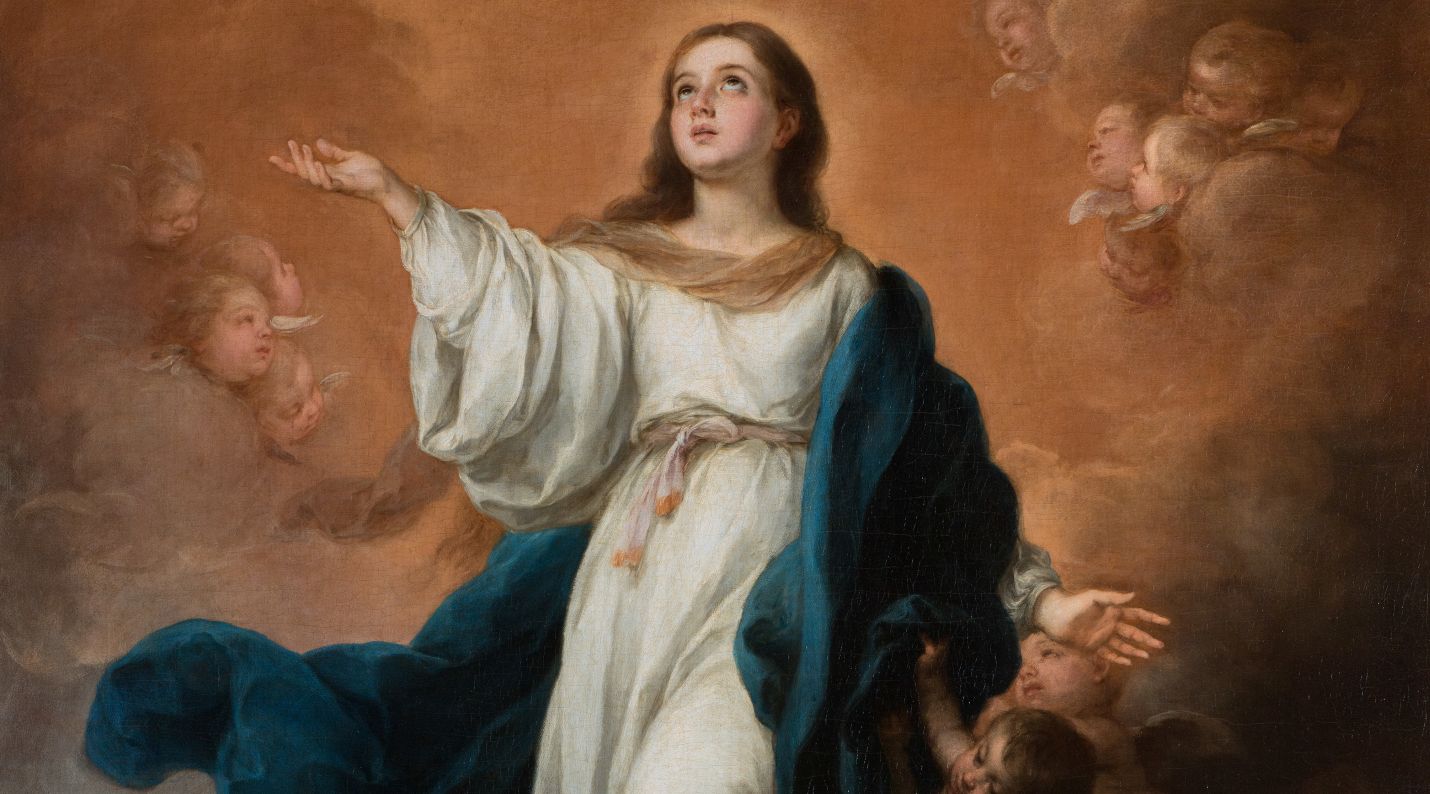
And the only perfect example we have of what it looks like to “go up” is, of course, her. Who? That one now at the right hand of the right hand. She is Mary, who in eternal designs from before all ages, the Father destined to draw to himself. From of old, the prophets sang a centuries-long “O Come, O Come, Emmanuel.” But from the foundation of the world God sang a far more earnest hymn of beckoning—for our Lady. She was the crown of his creation and providence: the true Ark, Daniel’s mountain, the icon of the Church, the one to at last crush the serpent’s head. In Eve’s fruitfulness. In Hannah’s humility. In Ruth’s fidelity. In Judith’s beauty, Susanna’s honor, and the courage of the mother of seven sons. She fulfills all types at once. She is before all others most desired by God, most loved, most revered, so much so that she was called from this earth by the Father, both soul and body. “Arise, my friend, my beautiful one, and come!” (Song 2:10). And so, what came down went up.
As this season of paradox ripens, we can meditate on the queen of paradox herself. Virgins do not become mothers. Handmaids do not become queens. Mary breaks the mold, the token that invites us to trust in and embrace God’s logic, a wisdom “mysterious and hidden” (see 1 Cor 2:6-10). And as the valleys were exalted at Christ’s entrance into the world through Mary (see Bar 5:7), we shall be exalted at his second coming just like our Lady. It is the same God to whom we will rise, by whom we will be drawn, the Lover who sent the angel “to a town of Galilee called Nazareth, to a virgin betrothed to a man named Joseph” (Luke 1:26-27). As the antiphon for the Assumption composed during the English Renaissance, the Vox Patris caelestis, makes plain, the hymn sung by the Father at Mary’s Assumption is one of great longing:
Come forth from your mortal body, and put on my vestment of gold . . .
Come to me, your most dear lover . . .
Come from that earthly mount Lebanon . . .
Come, my Esther, to your true Ahasuerus . . .
As you contemplate the Nativity scene this Advent, let your prayers wander to that realm where the girl of Nazareth now reigns beside her Son. And, with hope, long to hear that Father’s voice who longs to draw you, as he did Mary. As the hymn continues: “All the host of heaven with great desire are longing to look upon you; Come, come, come, and be crowned with heavenly glory. Amen.”
✠
Image: Bartolomé Esteban Murillo, Assumption of the Virgin