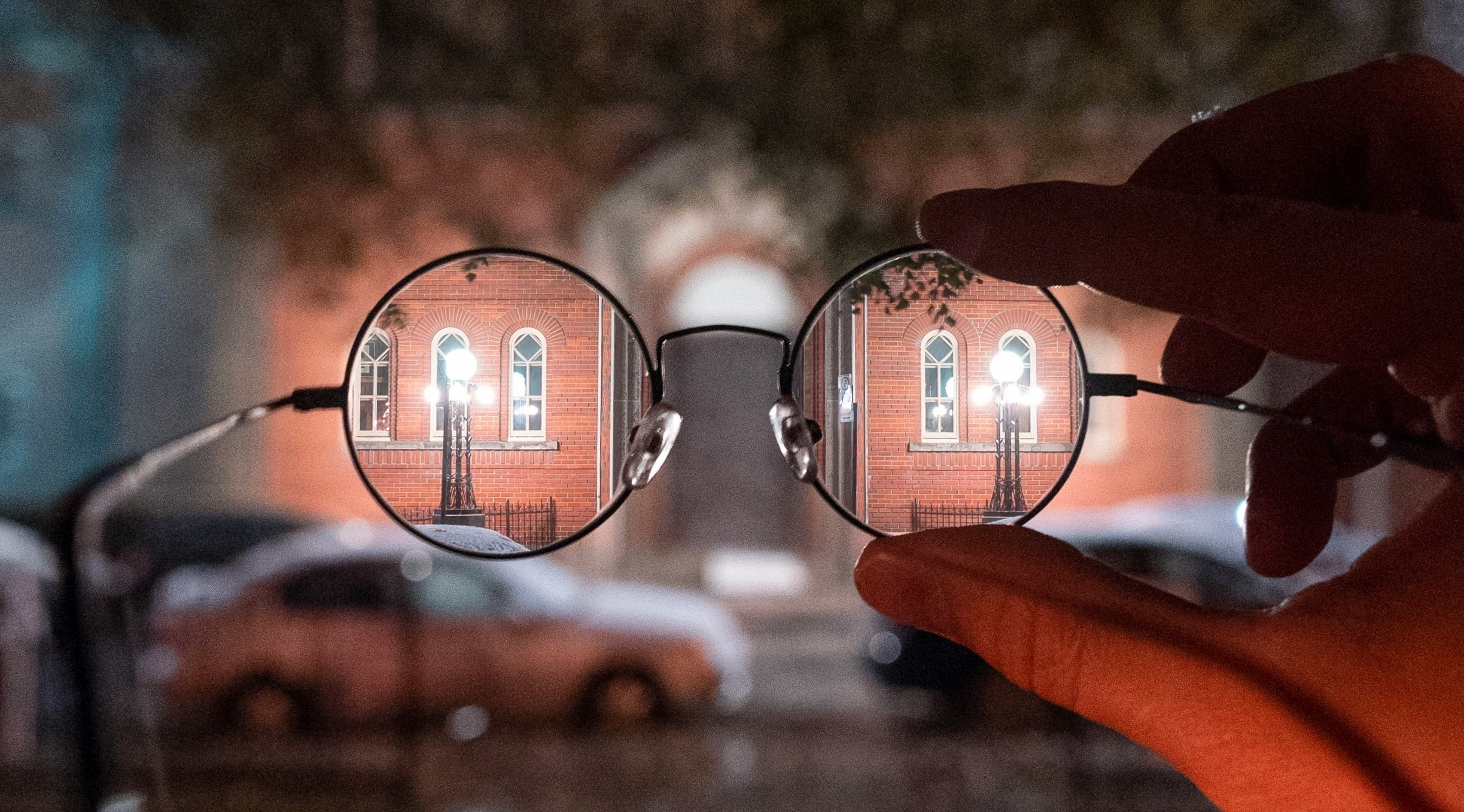
The fact that I needed glasses came as a surprise to everyone, most of all to myself. I was about eleven years old, having a late breakfast at Panera Bread after Saturday morning Mass with the family. My go-to order was a cinnamon roll, but that day I decided to try something new. But when I stepped up to the register, I was at a complete loss for what to order. “Just pick something from the menu,” my mother encouraged. I noticed what seemed to be a large white rectangle covered with indecipherable, dark markings. “I can’t read that,” I said, embarrassed, “it’s too far away.”
Like our physical sight, we may discover that our spiritual sight is far weaker than we had supposed. And weakened sight needs correction. Just as little Br. Simeon at the Panera needed glasses to see clearly, our spiritual sight needs a “prescription.” G. K. Chesterton observed that in religious art “the Christian saint always has [his eyes] very wide open. . . . The Christian is staring with a frantic intentness outwards” (Orthodoxy, ch. 8). The saint’s gaze is not fixed narrowly on himself, but turned outward toward a world of startling goodness, which points him onward to God, the author of all goodness. With this in mind, I suggest that disciplining our physical vision can train our spiritual vision. I wish to propose a pair of spiritual glasses: two “lenses” to treat our spiritual short-sightedness.
The first lens is our neighbor. Christ identifies himself with those in need, saying, “As you did it to one of the least of these my brethren, you did it to me” (Matt 25:40). How easy it is to forget this, focusing so intently on our personal goals that other people fade into a blurry background! But if we take these words seriously, we begin to see the face of Christ in each human being, and we find ourselves genuinely interested in his or her good. Of course, treating another person with dignity and love need not be extravagant. It may be as simple as meeting his or her gaze and granting them our full presence.
The second lens is God himself. Although God in his divine nature is invisible, Scripture repeatedly demonstrates the human inclination to look for him, especially in prayer: “To you have I lifted up my eyes, you who dwell in the heavens” (Ps 123:1). Christ himself “lifted up his eyes to heaven” to address his Father (John 17:1). This upward gaze draws our attention away from ourselves, reminding us of God’s greatness and of our own littleness. Furthermore, Christ has given us an even more immediate opportunity to see him in the Eucharist. Whenever we look upon the Blessed Sacrament, in Mass or in Eucharistic adoration, we are truly looking at Christ himself, who heals our self-focus.
The Mass, I have found, is the most fruitful place to train our spiritual sight. If we fix our eyes only on the priest, our perception of the liturgy can flatten into a merely human activity. Instead, we should allow our gaze to follow the action of the Mass. When the priest speaks directly to God, we can lift our eyes to heaven. Or when he addresses the congregation, as in the profound greeting “The Lord be with you,” we can look at him with gratitude and return a sincere “And with your spirit.” Or when he prays to Christ, we can look to the consecrated host on the altar. In this way, the body will help the soul to pray. Where the eyes go, the soul follows.
In this Christmas season, the Church invites us to contemplate Christ as Emmanuel, “God-with-us.” By taking on human flesh, God gives us a visible way to encounter him. Even now, he remains present to us in our neighbors and most especially in the Eucharist. Let us be watchful like Holy Simeon from the Gospel, who readily perceived the arrival of the Messiah and proclaimed, “My eyes have seen the salvation which you have prepared in the sight of every people” (Luke 2:30–31).
✠
Photo by Steven Wright on Unsplash