There is something proper about being astounded and in awe of a mystery, but there is something dangerous about being embarrassed by it. Sometimes it seems like we drift too close to the second option with the mystery of the Ascension. In addition to the nagging “why” questions, wondering if things wouldn’t have been better off if Christ had just stuck around, there are the dumbfounded “where” questions that wonder where Christ went when he left the apostles’ sight and where he actually is right now. These are not new questions, of course, and the tradition of the Church offers a great deal of reflection to guide us, reflection which seems quite apt at answering the “why” questions, but which can seem inadequate to answer the “where” question.
The Scriptures tell that as the apostles “were looking on, he was lifted up, and a cloud took him from their sight” (Acts 1:9). Every Sunday we profess that “He ascended into heaven and is seated at the right hand of the Father.” The Church has always been clear that the “right hand of the Father” should not be understood physically, for the Father is pure spirit; but does that mean we should try and understand “heaven” spiritually, too? If Christ’s body is only “in heaven” in a metaphorical sense, does he actually have a human body right now? There are a whole host of theological problems which arise if we deny the present existence of Christ’s body. For instance, what exactly is really present, body, blood, soul, and divinity, in the Real Presence of the Eucharist, if Christ himself, body, blood, soul, and divinity, is nowhere to be found? Given that we know, by faith, that Christ really exists in his full human body right now, then where exactly is he? Where exactly is heaven?
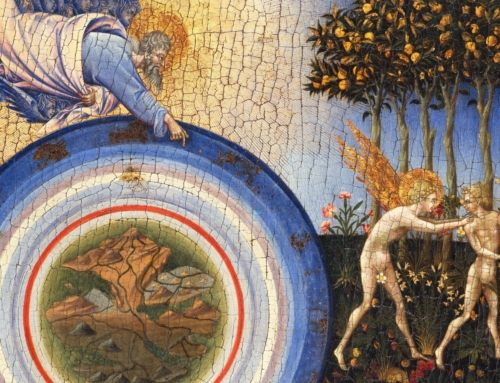
We can look for guidance from theologians of the past, but it seems like their answers will not do. St. Thomas, like so many before and after him, believed he knew exactly where the heaven of the Ascension was. Christ was present in the “empyrean heaven” beyond the outermost sphere of the stars. This empyrean, or fiery, heaven was a real physical place, but it was a precursor to the glory of the new creation, a precursor which exuded the very light of glory. It was separated from our corruptible order and beyond the reach of any natural observation. Not only was it physically difficult to get there, but even assuming you could find an Aristotelian rocket ship to get off the ground, it would literally take a miracle, the direct action of divine power, to pass through the solid, incorruptible heavenly spheres to get there. At the time, this seemed the best explanation of the plain meaning of the words, “he ascended into heaven,” but for us, with our general relativity, Apollo Program, and Hubble Space Telescope, it won’t do.
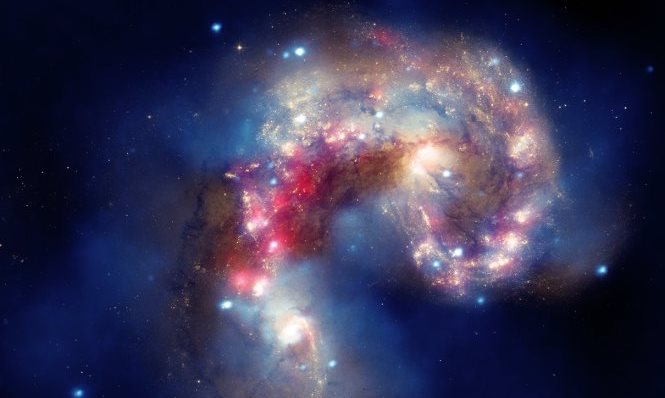
We know that the stars are not part of some fixed sphere made of an incorruptible aether, but dispersed throughout a vast amount of emptiness and made of a particularly beautiful and powerful combination of the same elements that we are. When we understand that Carl Sagan was right when he said, “We are made of starstuff,” no part of this familiar physical order, despite the amazingly beautiful pictures astronomers are constantly taking, seems distinct enough to be a fitting place for the resurrected and glorified Christ. It seems absurd to imagine him hanging out on some exoplanet around some star in some galaxy far, far, away. Even worse, we can’t even tell if there is an “edge” of our universe that we could get beyond, to try and find something less mundane. If only there were room in our scientific worldview for some real place that would be, in principle, beyond the reach of physical power and would have properties that would be completely unfamiliar to us, like the ancients had.
Oh… wait… there is. In fact there are whole classes of such places in a variety of physical theories. Colloquially referred to as “multiverse” theories, for some time physicists have proposed different types of physical places that are, in principle, inaccessible to us but help explain confusing physical phenomena. Some theories propose places that are simply extremely far away; others propose places that need not be far away but require traveling in a direction we can’t physically move in; still others propose places that are separated from us by something that can’t really be called a distance. Each of these theories has its supporters and detractors, but a good number of them are taken very seriously by the physics community and some of them might even be true.
I do not bring up multiverse theories to claim that science has solved the mystery of the Ascension. In fact, I am generally dubious of positing unobservable entities to explain scientific phenomena. That said, I find it helpful to consider the ways this work by serious physicists can expand our imagination about what it means to be “somewhere” and what types of real physical places are conceivable. As perplexing and confusing as modern multiverse theories are, the fact is that intelligent people are willing to take them seriously, and not without some reason. In that light, the belief that Christ really exists in heaven, in some physical place, in his glorified human body looks a little less embarrassing and a bit more properly astounding and awesome.
✠
Image: NASA, Galaxies Collide in the Antennae Galaxies