


No one would confuse my sisters’ and my art hanging on the refrigerator in our childhood kitchen as masterpieces worthy of exhibit at the National Gallery or even the occasional yard sale. They lack skill (the earth shaped like a bowl); they lack intelligibility (“Moth Daty IPP5”. . . or “Mother’s Day 1995” for those not fluent in kindergarten English); and they lack general aesthetic appeal. Yet to my mother, as to any, those works of ‘art’ are priceless treasures. They are priceless in spite of their imperfections because of love—my mother’s love for us and our love for her. This also characterizes our Lord’s love for us (Rom 5:6-8), but we can often get in the way of receiving that love because we expect perfection of ourselves.
We want to be perfect and know we ought to be. You need not be a “Type A” personality or a “perfectionist” to realize this. Everyone wants to be good at something because we want to be known for the excellence of our work. A childlike desire for perfection, on the other hand, is that shared joy at an imperfect masterpiece commemorating Mother’s Day 1995.
Our lack, our poverty, indicates the possibility for perfection. It is the space in which God works most visibly in our lives. If this is not understood, then the awareness of our imperfections becomes a heavy burden, even an obsession. Why do Silicon Valley tycoons obsess over anti-aging efforts if not because they know that they are mortal, that they will die? What helps explain a phenomenon like looksmaxxing except the potential to become more handsome or beautiful? So we hustle, we grind, or we walk, perfecting ourselves in our own image, but this misunderstands wherein lies our perfection and its means.
Our perfection originates in God’s love for us (1 Jn 4:9-12), and it is this love according to which Christ commands the disciples to be perfect (Matt. 5:48). Christ enjoins us to perfection out of love for God. It is the love of God, not the creation of an Olympian version of ourselves, that is the beginning and the end of perfection. Our efforts to improve ourselves aim at “the removal of obstacles to the movement of love towards God” (ST II-II, Q.184, Art.2). We strive to be perfect, to grow in virtue so that we can love God more perfectly.
Then, when we encounter Christ and he asks, “Do you love me?” we can say “Yes” and know that all will be made well, for love will make good all the defects in our work and in ourselves. But without it, all our good work is nothing (1 Cor 13:1–3).
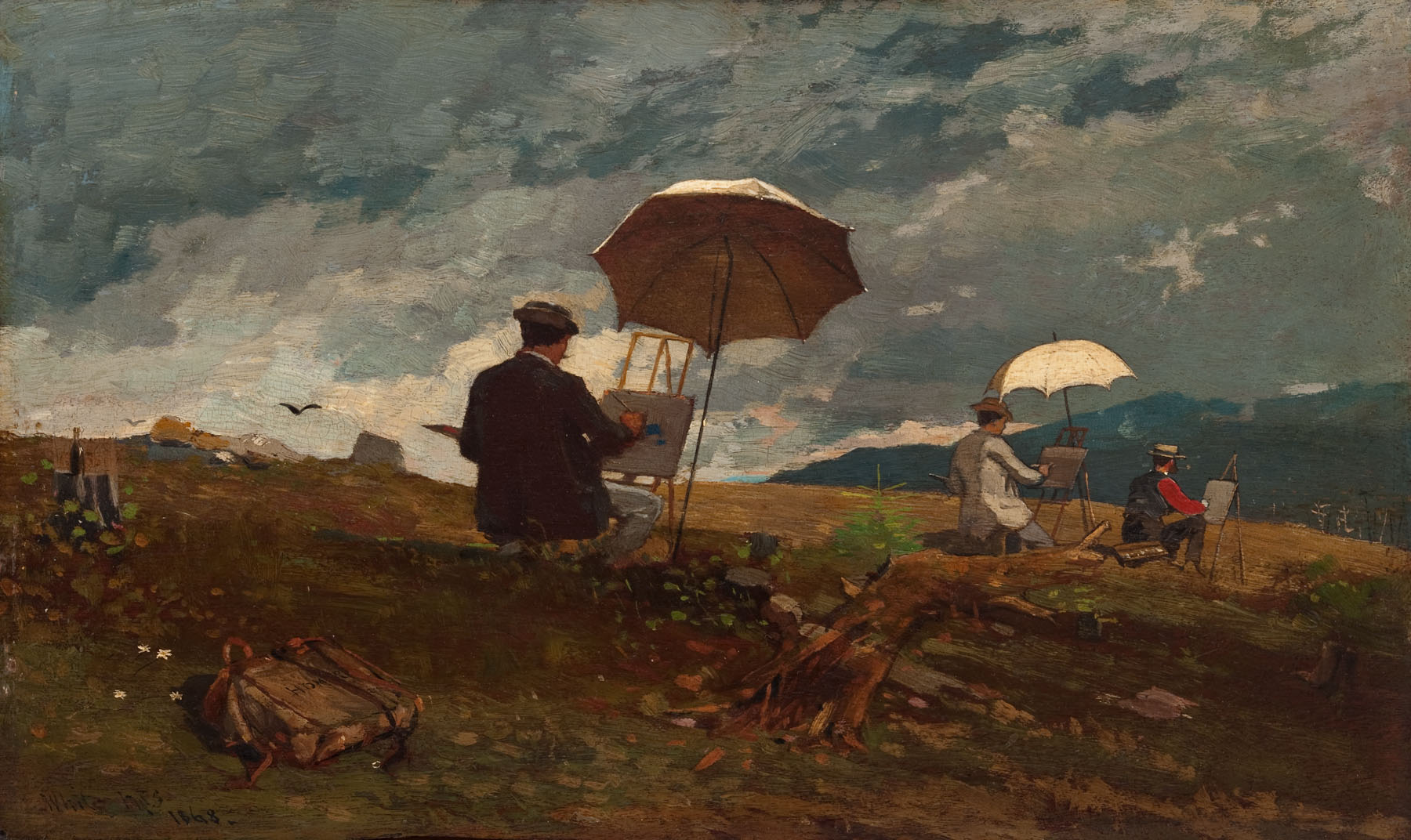
Image: Winslow Homer, Artists Sketching in the White Mountains